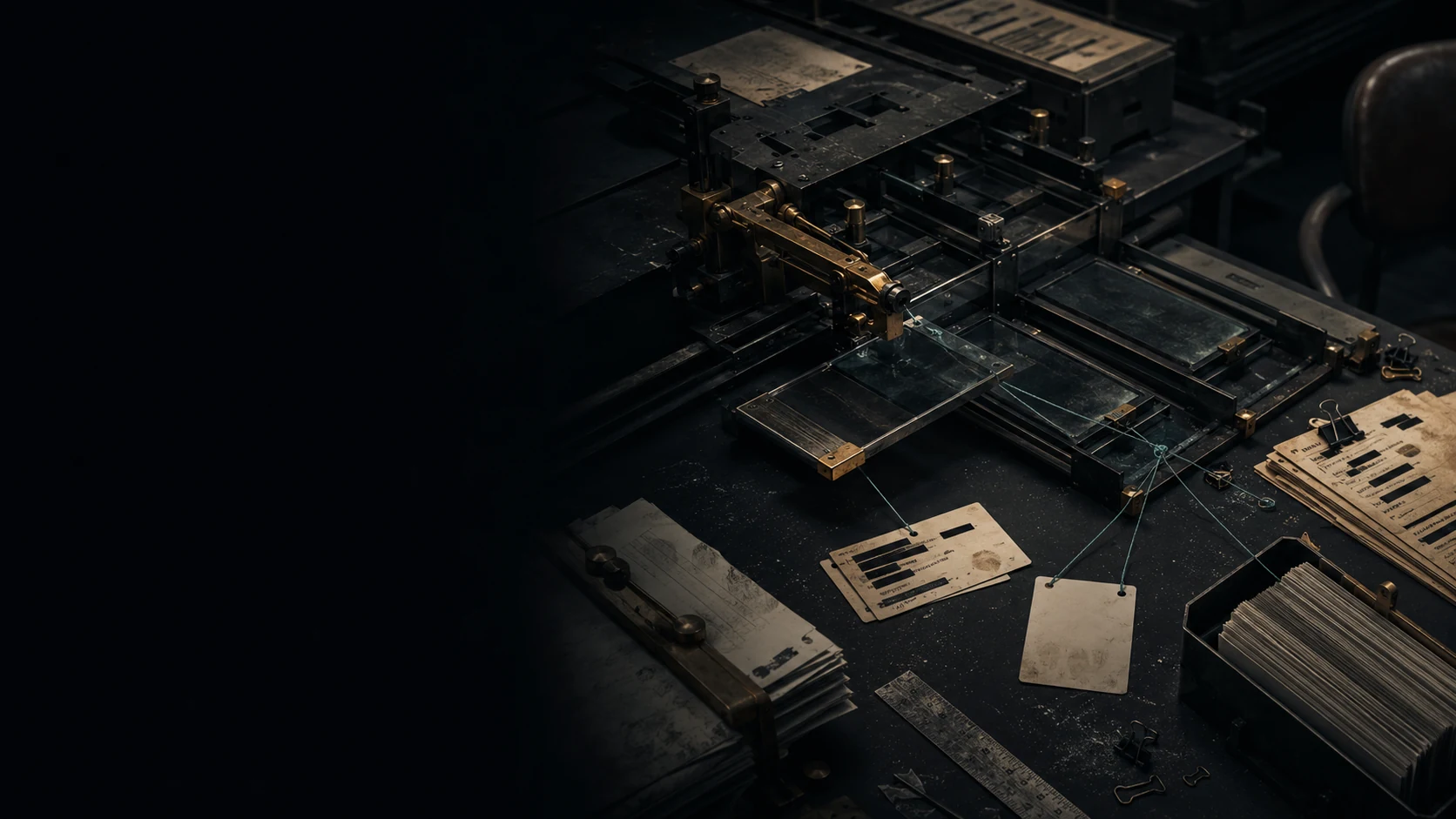
The chair is occupied.
That is the trick.
An empty chair would expose the problem too early. It would make the room ask who is allowed to stop the decision, who understands it well enough to carry it, who can say that the document is not ready just because it looks ready.
A body solves this.
The body has a title. A calendar invite. A name in the minutes. A rectangle somewhere in the chart. It listens while the recommendation is presented. It asks one careful question. It says the risk language should be tightened.
It does not say the sentence moving through the room like bad weather.
I do not understand this well enough to approve it.
The meeting does not need that sentence.
It needs the body.
Every organization has findings with no comfortable home. A number that does not fit the story. A customer sentence no one wants to transcribe. A process that has no living function left. A definition that everyone uses and nobody owns. A concern too real to dismiss and too inconvenient to accept.
These findings arrive all the time.
The organization rarely ignores them.
That would require courage.
Instead, it notes them.
There is a difference.
Ignoring a thing makes the room guilty. Noting it makes the room responsible-looking. The concern enters the minutes. It receives a follow-up owner. It becomes an action point, a dependency, a risk note, a parking-lot item, a thing to clarify after the meeting.
The room moves on.
The finding has been handled.
Not understood.
Handled.
This is where judgment disappears. Not in the dramatic moment where someone chooses denial. That would be easier to accuse. It disappears in the polite sequence after the uncomfortable thing has entered the room and no one knows what to do with it.
First the room asks whose area it is.
Then it asks who owns the system, the process, the customer, the data, the policy, the model, the channel, the definition, the old decision, the new consequence.
The answer is usually soft.
Everyone.
No one.
A steering group.
A function.
A person on paper.
A person everyone knows does not really own it.
The room spends its seriousness on locating responsibility.
By the time someone receives it, the seriousness is gone.
The thing becomes smaller in the transfer. The concern becomes a note. The note becomes a task. The task becomes wording no one is afraid of. Someone will look into it. Someone will align. Someone will clarify ownership. Someone will come back with a proposal.
The note dies with a name attached.
This is not a failure of documentation. The documentation is often excellent. That is part of the problem. A documented concern can feel morally different from an unresolved one. The organization can point to the trace and say the matter was captured.
Captured is a strange word.
Some truths are captured so they can stop moving.
The judge is missing because the organization has learned to process what it cannot afford to know. It has rooms for escalation, forums for alignment, templates for risk, dashboards for status, owners for follow-up, and language for almost every condition except the one that matters.
This should stop.
That sentence is expensive.
It damages the room. It turns a meeting from coordination into consequence. It makes the person who says it look difficult before they look right. It asks the organization to hold the finding at full size instead of shrinking it into a manageable object.
Most rooms are not built for that.
They are built to move.
AI will make this worse in a specific way. Not by removing humans from the loop. Many humans will remain. They will review, approve, challenge, sign, request changes, ask for clearer risk language, and sit close enough to consequence that the organization can still call the process human.
The body will survive.
The question is what it covers.
The machine is useful in the room because it helps the finding become presentable. It can summarize the concern. It can make ambiguity sound balanced. It can turn contradiction into options. It can draft the risk paragraph, soften the customer complaint, clean the unresolved definition, and produce a version of the problem mature enough to circulate.
A weak thought with posture is harder to stop than a weak thought with bad manners.
The machine does not need to decide.
It only needs to help the room move past the moment when judgment was still possible.
The case becomes easier to approve and harder to judge. The document looks finished. The recommendation has shape. The risks have names. The uncomfortable thing is still there, but now it has formatting around it.
Doubt begins to look personal.
The last person who does not understand the decision becomes the problem in the room. Their hesitation threatens more than the timeline. It threatens the fiction that the room has already understood itself.
So they choose a smaller sentence.
Can we clarify the ownership?
Can we add a note on the assumption?
Can we capture this as a dependency?
The room accepts this form of doubt because it does not interrupt the decision. It improves the artifact. It preserves motion. It lets the person remain intelligent without becoming dangerous.
That is often enough.
Not enough to judge.
Enough to continue.
The mandate is arranged just badly enough. Strong enough to create blame. Weak enough to avoid force. A person is expected to see the issue, care about it, flag it, help shape it, document it, maybe own it later, and explain afterward why it did not become more serious sooner.
But the right to stop remains unclear.
A mandate negotiated every time is not a mandate.
It is a hope with a job title.
After failure, the organization becomes fascinated by the missing stop.
Why did no one raise this?
Who owned the decision?
Why was the risk accepted?
The questions sound serious because damage makes seriousness affordable. Before the damage, the same organization rewarded other qualities. Speed. Alignment. Pragmatism. Constructiveness. The ability to turn discomfort into language the process could absorb.
The warning was heard.
That was the problem.
It was heard as input.
No one had given it the shape of a stop.
This is why the judge is not a hero. A hero would make the story too kind. If judgment depends on someone becoming brave at the exact moment the organization has made bravery socially expensive, the system has already chosen its answer.
The judge is a place.
A place where an uncomfortable finding does not immediately become an ownership question.
A place where a note is not mistaken for seriousness.
A place where the person in the chair is not used as evidence that judgment occurred.
A place where the room stays with the thing that has no comfortable home until someone understands what it costs.
Most organizations will ask for a framework instead.
There is always a framework when shame needs somewhere to sit.
The framework will have principles, escalation paths, review forums, assurance language, red lines, decision rights, model cards, and a diagram where responsibility moves cleanly from left to right.
Some of it will help.
Some of it will become another chair.
The final risk is not that machines make decisions while humans disappear. The final risk is that humans remain exactly where the organization needs them, seeing just enough, saying just enough, approving just enough, so that no one has to admit how little judgment the room could bear.
The document will be improved.
The risk will be noted.
The owner will be assigned.
The meeting will end on time.
The body will stay in the chair.
The finding will die politely.